
When I talk about “low-carbon energy” I mean renewables and nuclear.1 I thought this would be clear to everyone, but survey data suggests otherwise.
Most of the public says that renewables are low-carbon. On nuclear, they’re confused.
There are lots of valid debates to be had about the role that nuclear should play in our energy mix: costs, construction times, waste management. Whether it’s low-carbon is not one of them. The life-cycle emissions of nuclear are just as low – if not lower – than solar and wind.2 And the main point is that all three are much lower than fossil fuels.
But when you look at public surveys, people are confused about this.
A 2021 survey by YouGov asked over 3,000 people in the UK about the carbon intensity of different energy sources.
For each, they had to say whether it had no carbon emissions, low, moderate, high, or that they don’t know.
Now, I think the category “no carbon emissions” is confusing here – I would have started the options at “low”. While some energy sources have no direct tailpipe emissions, they do have small amounts of life-cycle emissions.
In the chart below I’ve combined “no” and “low” emissions votes. You can see that most people know that solar and wind are low-carbon. 81% agreed, and only 5% disagreed. 14% said they didn’t know.
They also knew that coal and gas were high or moderate emissions sources.
But under half – 46% – knew that nuclear was low-carbon. 30% thought it was moderate or high. And more people said “don’t know” compared to other energy sources.

Other surveys report the same confusion. A 2020 study by the UK’s Institution of Mechanical Engineers found that just under half (48%) of UK adults knew that nuclear energy was low-carbon.
It’s also true in the US. A survey of almost 3000 adults found that 27% thought nuclear power was a “very major” or “major” cause of climate change. An additional 29% thought it was a “moderate” cause.
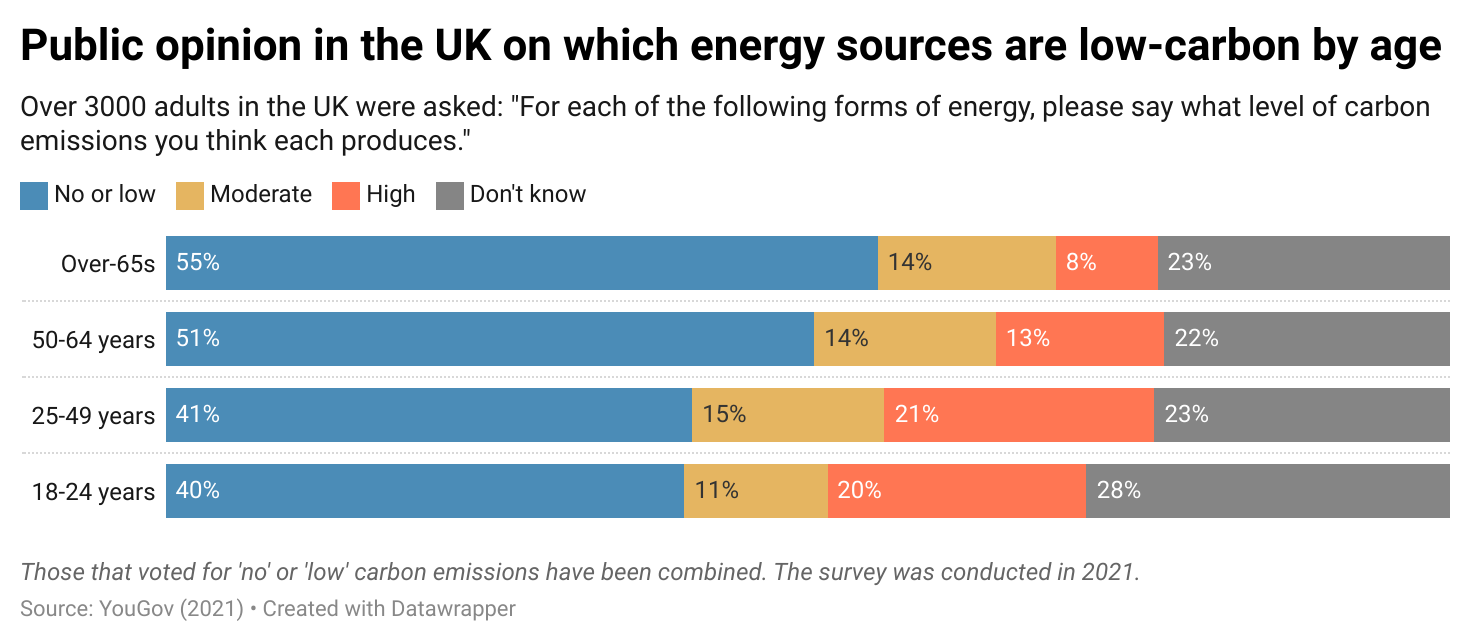
Older people and men are more likely to say that nuclear power is low-carbon
The survey results show interesting demographic patterns.
Older people are more likely to say that nuclear is low-carbon. In the chart below I’ve shown the age breakdown from the 2021 YouGov survey.
55% of over-65s said it was low-carbon, compared to 40% of 18-to-24-year-olds.
The survey from the Institution of Mechanical Engineers (IMechE) found the same but with a much lower share for young people. Just one-quarter (26%) of the 18-to-24-year-olds said it was low-carbon. The share among the oldest age group was 61%.
Note that the large differences between the younger shares should warn us about focusing too much on specific numbers – 40% or 25%. Honest surveying is hard, and how you ask the question matters. But, consistency in the patterns of results is an important signal.
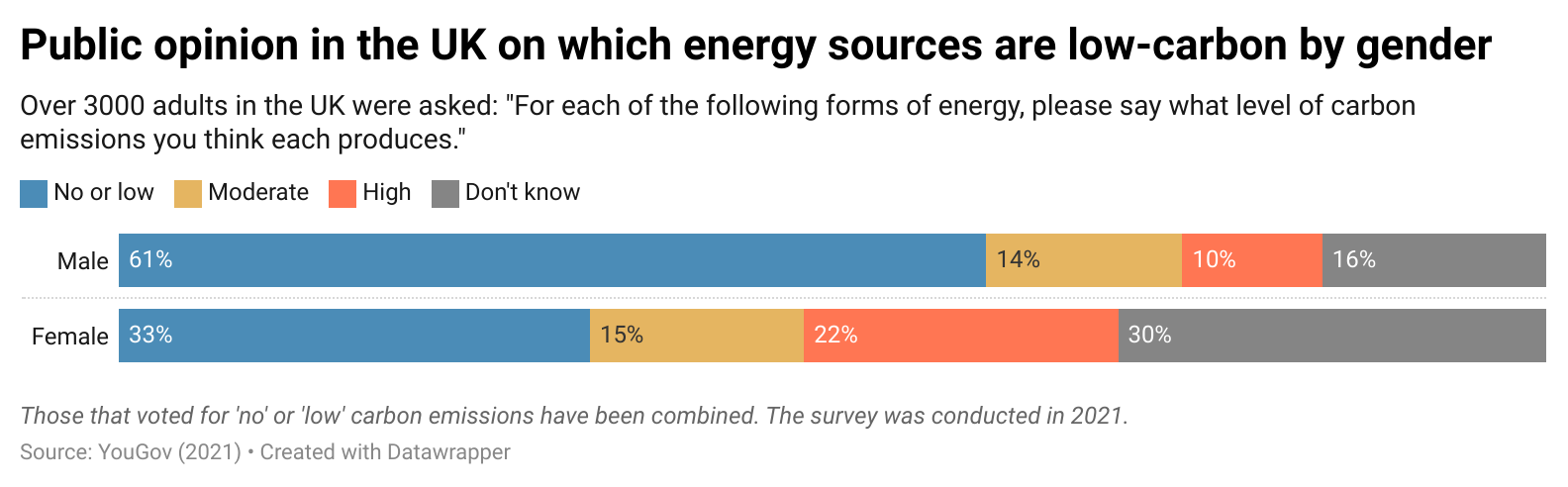
Most surveys also find a strong gender divide. Men are more likely to say that nuclear is low-carbon. In the YouGov survey, 61% of men thought so, compared to 33% of women. The IMechE survey found a similar gap: 60% for men, and 36% for women.
Women were also much more likely to say “don’t know”.
Why are people confused about nuclear power?
It’s hard to know exactly why people have such mixed views.
In 2021, Kenton de Kirby and Ted Nordhaus from The Breakthrough Institute published a large report about public attitudes toward nuclear power.3 If you’re interested in this area, it’s well worth your time.
One of their conclusions – which I agree with – is that many people hold these opinions about whether nuclear fairly lightly. I don’t think many people are convinced that nuclear emits lots of carbon dioxide, and are unwilling to budge. I think nuclear is just poorly understood, and people are genuinely unsure. They associate nuclear with dirty and polluting fuel, and that makes them think that it emits carbon.
There are a couple of broader perceptions about nuclear power that lead people to this conclusion.
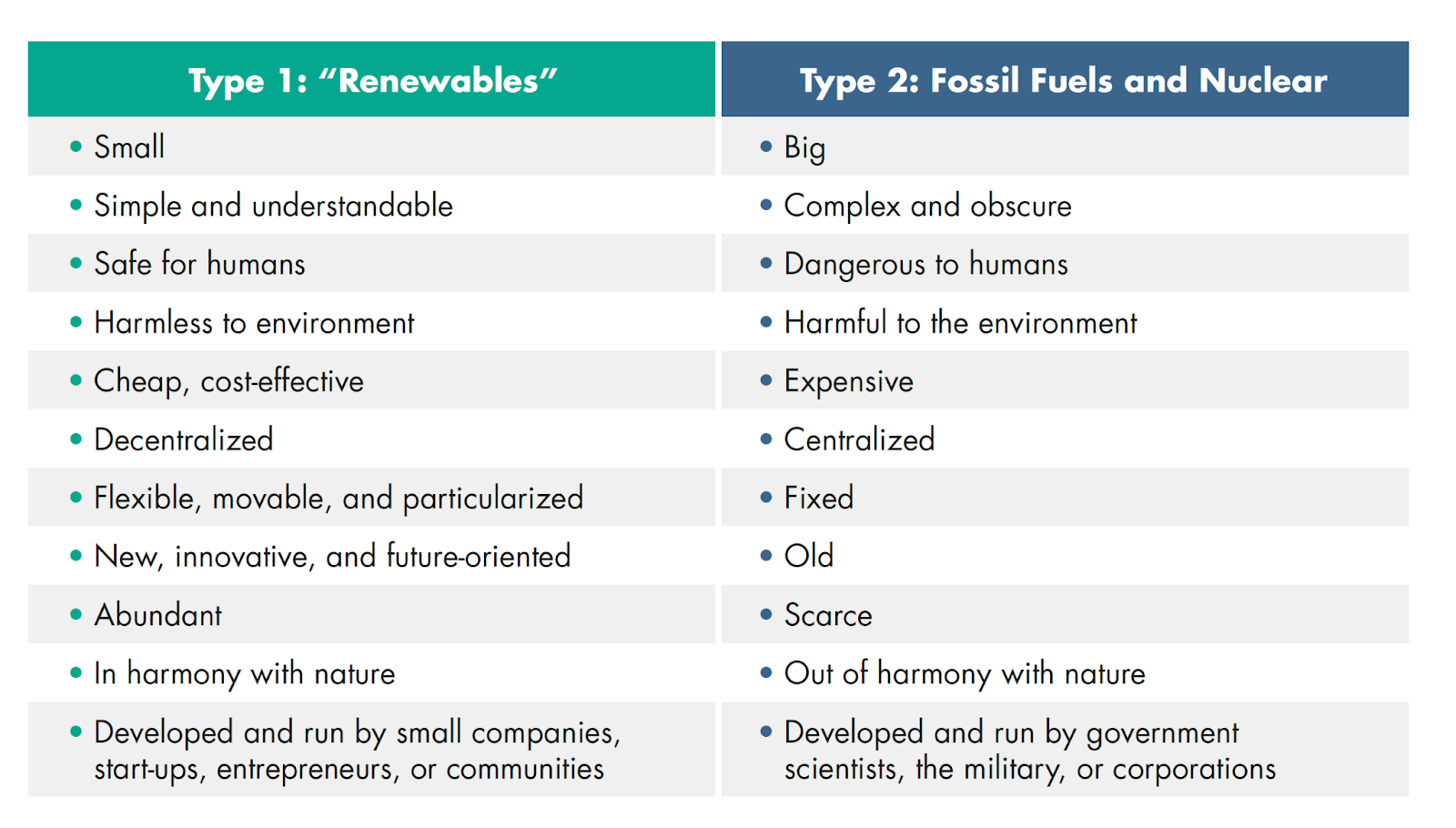
As de Kirby and Nordhaus note, the imagery of nuclear power is much closer to a fossil fuel plant than a solar panel or wind turbine. Energy sources could be split into two types: “renewables” and “fossil fuels and nuclear”.
Solar and wind plants are seen as small, simple, and decentralised. Fossil fuel or nuclear plants are big, complex, and centralised. There’s also an important time component: solar and wind are ‘new’ technologies whereas nuclear is an old technology that had ‘its moment’ decades ago. That might also explain why older people are more likely to say that nuclear power is low-carbon: 30 years ago, alongside hydropower, nuclear was the low-carbon energy source. Now the emblem of low-carbon is solar and wind.
A major report by Zero Ideas also looked at public opinions on nuclear power. In another post, I’ll dig into it in more detail. But one interesting question was about the icons used to represent nuclear power.
The classic image of cooling towers was the least popular and gave the worst impression.
This is not surprising when you think about it. What do they look like? An old coal plant spewing pollution into the atmosphere. People see the white smoke from a cooling tower and assume nuclear and coal plants are similar. I’ve used the iconic ‘cooling tower’ image for article thumbnails in the past, but I’m going to stop.
It reinforces the notion that fossil fuels and nuclear are close cousins. What the world needs is for people to see renewables and nuclear in this way, instead. As I’ve said many times before: it shouldn’t be renewables versus nuclear; it should be low-carbon versus fossil fuels. Nuclear is firmly in the former camp. We need to find a way of communicating this to the public.
Maybe not biomass…
United Nations Economic Commission for Europe (2021). Carbon Neutrality in the UNECE Region: Integrated Life-cycle Assessment of Electricity Sources.
Kenton de Kirby and Ted Nordhaus (2021). Nuclear Cognition: Public attitudes, elite opinion, and the next generation of nuclear energy communications. The Breakthrough Institute.